What Happens When Agencies “Move Houses” Without Properly Packing First
Moving across the country into a bigger house sounds exciting until moving day arrives and reality sets in.
The truck shows up on time and the movers are ready, but the boxes are labeled loosely. Kitchen. Bedroom. Office. In the old house, that level of labeling was good enough. In the new one, with more floors, more rooms, and clearer boundaries, it quickly falls short.
Suddenly, the challenge is not how fast everything can be unloaded. The real question is whether what is inside each box actually belongs where it ends up.
That experience mirrors what many agencies encounter during a Defense Agencies Initiative (DAI) migration.
DAI Is the New House Whether You Are Ready or Not
DAI is the Department of War (DoW) enterprise financial management system intended to transform budget, finance, and accounting operations so agencies can achieve accurate and reliable financial information for accountability and decision making.
For many agencies, transitioning to DAI is mandated. What is not mandated is the level of discipline used to prepare for the move.
DAI is not challenging because of volume. It is challenging because of the labor intensive work required to deconstruct and rebuild each data element so it conforms to rigid structural rules. Before cutover, an agency’s historical financial story must be rebuilt so DAI can understand it.
What We Have Learned After 16 Years and 26 Migrations
CSCI has supported DAI deployments for more than 16 years and has supported 26 DoW organizations in deploying DAI as their financial management platform.
That experience shapes how Christie Conner, Senior Director of Project Delivery, approaches every DAI migration she leads.
Christie has served from 2010 through 2020 as a General Ledger subject matter expert and project manager on DFAS DAI, leading general ledger conversion, reconciliation, and data validation for 21 Other Defense Organizations.
“Most migrations fail on preparation, not on moving day. The system just makes the gaps visible.”
– Christie Conner
The Hidden Work Behind the Move
After enough DAI migrations, a consistent pattern becomes clear. The challenges that surface during transition are rarely about the system itself. They emerge when familiar ways of organizing information are moved into a system that requires far more precision.
If a cross‑country move is going to go smoothly, the work starts well before the truck arrives. The same is true for DAI.

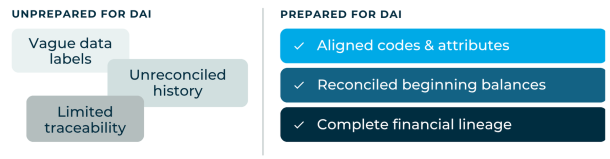
Attribute and Code Alignment
In a larger house, familiar labels stop working. A box marked bedroom is no longer specific enough. New labels like bedroom one, basement storage, and pantry are needed to represent different destinations in a new house. DAI introduces the same requirement for clarity. Legacy codes and attributes must align precisely to DAI’s schema and rule set so data lands where it belongs in the new environment.
Data Cleansing
As labels become more precise, it becomes clear that not everything from the old house belongs in the new one. Items kept out of habit like broken furniture, outdated paperwork, or mismatched sets add clutter instead of value. The same dynamic applies in a DAI migration. Legacy data that is obsolete, invalid, or misaligned with DAI rules must be identified before the move.
Carrying forward data that no longer serves a purpose increases reconciliation risk and obscures the financial story agencies are responsible for preserving. Thoughtful cleansing ensures that only intentional, defensible data makes the transition and that it arrives ready to function in its new environment.
Historical Reconciliation
Once items are clearly labeled, the next step is knowing exactly what is being moved. Before the truck doors close, the inventory and the physical count must match. If the paperwork lists 26 boxes and only 25 appear, the move pauses. DAI works the same way. Variances and unmatched activity can block conversion, and beginning balances must be fully reconciled before cutover.
Complete Financial Lineage
Finally comes traceability. Each box should be trackable from inventory list, to truck manifest, to delivery receipt. That chain of custody builds confidence that nothing was lost or misplaced. DAI requires the same end‑to‑end linkage across financial transactions. When lineage is incomplete, confidence declines and resolution becomes more difficult after go live.
“The smoothest transitions are not the ones without challenges. They are the ones where nothing comes as a surprise.”
– Christie Conner
This Is Pattern Recognition Not Theory
After enough migrations, the same failure points stop being surprising. Agencies that transition cleanly are rarely the ones with the most dramatic cutover weekends. They are the ones that do the unglamorous work early and iteratively, when issues are easier to resolve and simpler to govern.
They reconcile before they rush. They define before they migrate. They ensure their financial story is coherent before asking a new system to tell it.
A DAI Migration Is Won Before Cutover
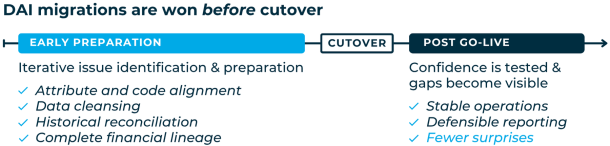
A successful move is not defined by how smoothly cutover weekend goes. It is defined by the choices made long before that date arrives. Clear labels. Reconciled histories. Financial activity that can be traced without explanation. Those decisions determine whether an organization settles into DAI with confidence or spends years correcting avoidable issues.
That is why DAI migrations are ultimately a stewardship exercise. When data is trustworthy, reporting is defensible. When reporting is defensible, leaders can make decisions with confidence.
CSCI has supported DAI migrations across the D0Wfor more than 16 years, and leaders like Christie Conner have seen firsthand how preparation shapes outcomes. After dozens of conversions, the pattern is clear: the agencies that succeed are not the ones that move faster. They are the ones that prepare with discipline and confront issues early, while they are still manageable.
If your organization is preparing for a DAI migration or working to stabilize after cutover, having experienced DAI practitioners involved early can reduce risk, limit disruption, and protect the credibility of your financial data.
The question is not whether you are moving. It is whether you know exactly what you are bringing with you.